
DIASPORA
The Mission Field Has Moved

By Kelly Seely
For years, many of us in European missions have held a compelling assumption: that diaspora communities are a bridge for sending the gospel "back" to their countries of origin. We've viewed believers from China, Iran, and Africa as a strategic force to be mobilized for their homelands. But what if long-term, on-the-ground reality tells a different story? What if the most strategic mission field for diaspora believers is not "back there," but right here in the multicultural cities of Europe? This post explores five takeaways that demand we reframe our understanding of diaspora mission.
1. The "Back-to-the-Homeland" Strategy Is Mostly a Myth
A core strategic assumption is that diaspora believers will be the most effective long-term missionaries to their countries of origin. We envision them planting churches and leading movements back in the places they or their parents left behind.
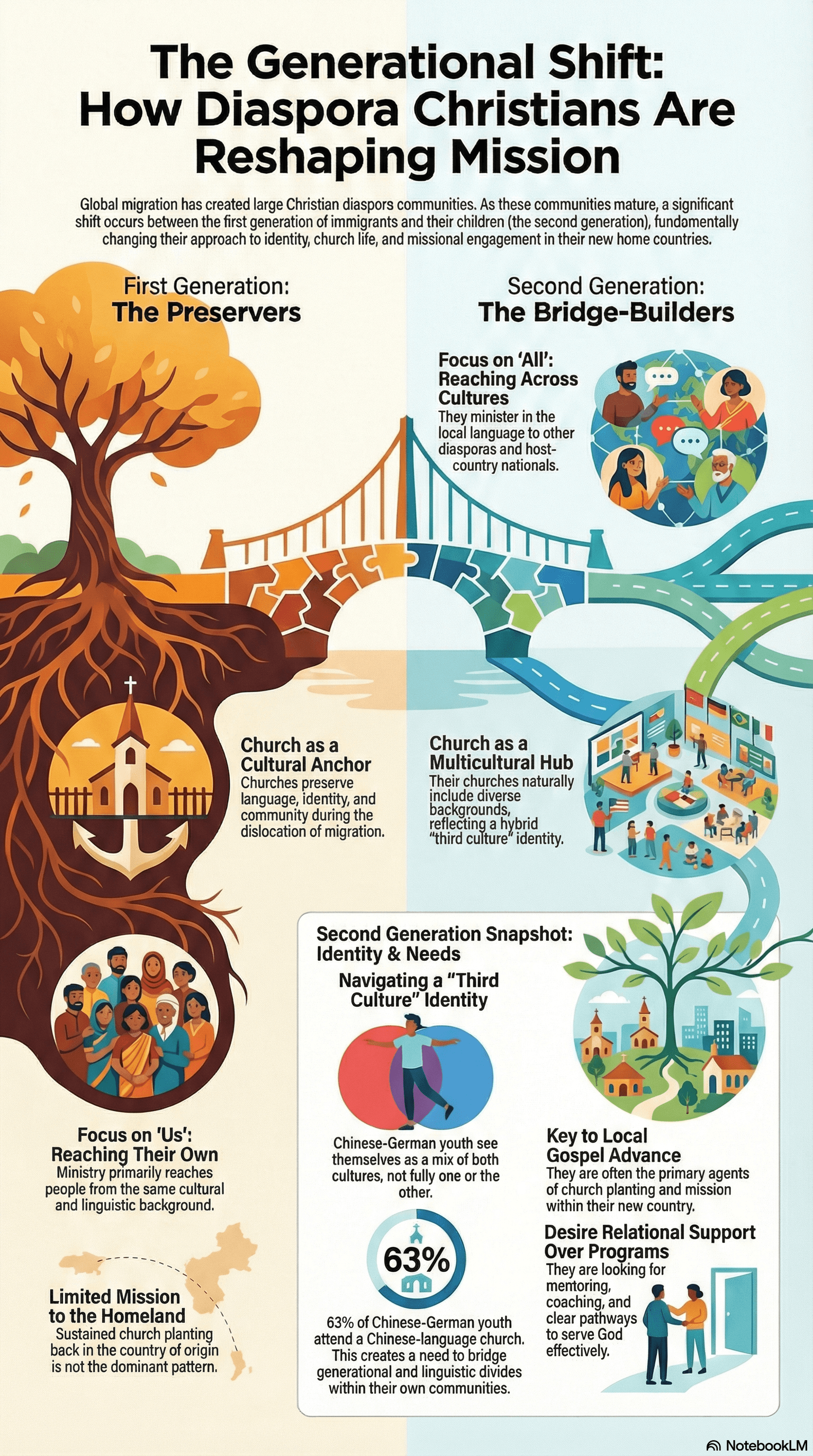
However, on-the-ground reality tells a different story. Across Europe, there is no strong, sustained pattern of diaspora churches launching long-term missionary or church-planting movements back to their homelands.
Across Europe, we do not see strong, sustained patterns of diaspora churches effectively reaching back into their countries of origin with church planting or long term missionary movements. While isolated examples exist, this is not the dominant pattern.
This isn't to say it never happens. We see courageous individuals, like Chinese pastors from North America who return to China at significant personal risk, but these are exceptions, not the rule. A more consistent exception is found among Persian believers, who show notable engagement back into the homeland, often through sophisticated digital platforms. Yet even this remains a distinct pattern, not the norm among the diverse diaspora groups in Europe. This insight demands a fundamental reorientation. If we continue to invest in a strategy that does not reflect reality, we are not just being inefficient; we are squandering the most potent missional force currently at work in Europe.
2. Europe Is the Primary Mission Field for Its Diaspora
If the mission isn't primarily "back there," then the data suggests it is powerfully and effectively "right here." The most significant missional impact of diaspora communities is happening within the borders of Europe itself, but it unfolds generationally.
First Generation: First-generation believers primarily reach their own linguistic and cultural groups. A Chinese church in Germany reaches other Chinese; a Korean church in France reaches other Koreans. These churches are vital, providing essential pastoral care and serving as community anchors.
Second Generation: With the second generation, there is a decisive shift. As native speakers of German, French, or Italian, their missional expression naturally moves toward local-language, multicultural ministry. For them, planting multicultural churches is not a special project; it happens "by default, rather than by design."
The evidence for this shift is compelling and widespread:
In Italy, a Chinese church has started an Italian-language church.
In Spain, Chinese and Spanish churches partner for joint street evangelism in mixed teams.
In North America, a Chinese church in a changing neighborhood is now effectively reaching its new South Asian neighbors.
This growing missional impulse, cultivated in a European context, is even looking outward in new ways. In France, Chinese churches that are now asking for training on how to better reach their non-Chinese neighbors at home have also sent mission teams to West Africa and North Africa. This represents a clear sign of gospel ownership that is distinct from the old "back-to-the-homeland" model. Crucially, these second-generation-led churches are often more effective at reaching spiritually open, multicultural Europeans than many historic, mono-cultural European churches.
3. The Generational Gap Is a Strategic Chasm
If the second generation is the key to mission in Europe, then failing to understand them is a critical strategic failure. A survey of German-Chinese youth, their parents, and church leaders reveals a deep chasm of misunderstanding.
The data shows a significant disconnect in perception:
Identity: The youth see themselves as a mix of German and Chinese. Their church leaders, however, often perceive them as mostly German.
Language: While 40.4% of parents rate the use of German as "very important" for their children's spiritual growth, many churches struggle to provide effective ministry in the language their youth actually speak as their mother tongue.
Furthermore, the survey notes that the youth's "missional vision is very low." But a closer look reveals this isn't a lack of faith. Their top priorities are foundational life and spiritual goals: maturing in faith (85.2%), developing good character (81.5%), and getting married and having children (75.3%). They are focused on being before doing. This highlights the strategic collision course: while leaders are focused on institutional continuity ("staying in our church"), the youth are focused on personal authenticity ("maturing in faith"). This unaddressed difference in focus is the engine of the strategic chasm.
4. The Biggest Barrier to Mission Isn't Hostility. It's Uncertainty.
We often describe Europe as a post-Christian, spiritually resistant mission field. We assume the primary barriers are external. However, a survey of young, often diaspora-background participants at a recent conference (AWAKEN) paints a different picture. The most significant barriers they report are not external opposition but internal uncertainty.
The top reported barriers to engaging in mission were:
Lack of clarity of calling
Need for training and preparation
Fear or uncertainty
Financial concerns
This internal focus is particularly pronounced among second- and third-generation participants, who articulate their sense of calling in more complex terms, often involving "tension, complexity, and identity negotiation." For leaders, this means our mobilization efforts should focus less on overcoming a hostile culture and more on providing guidance, discernment, and clarity for emerging leaders navigating complex internal questions about their identity and purpose.
5. Leaders Should Build Pathways, Not Just Programs
Synthesizing these points leads to a clear, actionable conclusion. To empower the emerging generation of diaspora leaders for mission in Europe, we must shift our approach from creating programs to building pathways.
The conference survey revealed that participants' desire for relational support like "mentoring or coaching" and "clear pathways" far outweighs their desire for abstract information. This aligns perfectly with the needs identified in the German-Chinese church survey. When church leaders were asked what they needed most, their top answers were "German speaking youth workers" (89.3%) and "Understanding the 2nd Generation's worldview" (82.1%). Both are relational and foundational, not programmatic.
This exposes the inadequacy of common programmatic "solutions," such as the "Transfer Model," where a Chinese church simply sends its youth to a local German church. This approach, while inexpensive, often leads to the "loss of second generation in Chinese churches" by breaking spiritual ties with their families and home church. It's a role-filling solution to a relational problem. We must move from "role-based recruitment" to "pathway-based recruitment," investing in a person's journey, walking alongside them through their uncertainty, and helping them find clarity. This relational approach is what will truly equip second-generation leaders to step into their missional calling within Europe.
A Final Thought
The evidence is clear: the locus of diaspora mission in Europe has shifted. It is no longer primarily a bridge "back" to other countries but has become a vital, multiplying force for the gospel within Europe itself. Second-generation leaders are already planting local-language, multicultural churches that are reaching Europeans in ways many traditional churches cannot. Additionally, such churches often are multiplying majority culture leaders who are more culturally aware and become more effective in bringing the gospel to diverse peoples.
This is not a future trend to prepare for; it is a present reality to recognize and support. The missional renewal of the European church may well depend on our ability to answer the essential question that should guide our strategy for years to come.
The strategic question is not whether this is happening. The strategic question is whether our language, structures, and expectations will align with what is already emerging on the ground.